
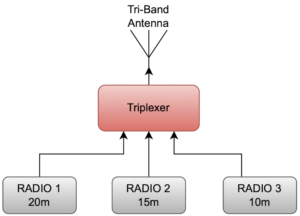
In the world of modern amateur radio, where every second counts and efficient use of space is paramount, the triplexer has become an almost essential device. It allows a single multi-band antenna (such as a Tribander) to function as if it were three independent monoband antennas.
What does it look like and how is it built?
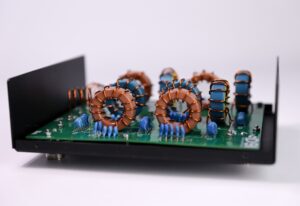
The triplexer is a device housed in a metal enclosure, typically equipped with four RF connectors (SO-239 or N-type). One connector is used for the common antenna, while the other three are dedicated to specific bands: 20m, 15m, and 10m.
Technically, it is a precision system of three filters—low-pass, band-pass, and high-pass—connected at a single point. Inside, you will find high-quality iron powder toroids, air coils, and specialized high-voltage capacitors designed to handle high currents while maintaining minimal losses.
Multi-Operator operation: No limits on transmitting
A key advantage of the triplexer in Multi-Operator configurations is the ability to transmit from several transmitters simultaneously into a single antenna. There is no restriction requiring only one band to transmit at a given time. Each operator (on 20m, 15m, and 10m) has full freedom to work as if they were using three independent antennas, which drastically increases station efficiency.
Isolation and filters – The key to safety
The triplexer alone typically offers adjacent band isolation of at least 30 dB. While this is a solid figure, it is not sufficient to protect sensitive receivers from the strong signal of a transmitter operating on an adjacent port.
- For safe and comfortable operation at Low Power, the total system isolation should be at least 70 dB.
- To achieve this, the use of external Band-Pass Filters (BPF) is mandatory.
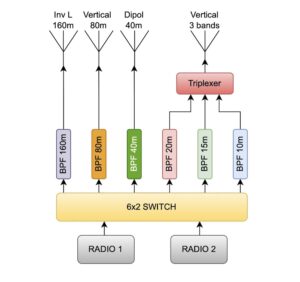
Which filters to choose? It is best to rely on proven, high-selectivity designs such as those offered by SO9I Engineering, VA6AM, or W3NQN. These filters must be connected between each radio and its corresponding port on the triplexer to ensure a “clean” signal and full protection for your equipment.
Applications: From skimmers to SO2R
- SO2R (Single Operator 2 Radios): This setup allows a single operator to listen on one band while transmitting on another using the same antenna.
- SDR Skimmers: You can use an unused port on the triplexer to connect an SDR receiver that continuously monitors activity on a different band. This can function as a local skimmer, filling your band map with stations you can actually hear on your own antenna.
Cost Analysis: Why is it worth it?
Let’s compare two approaches to building a station for the 10, 15, and 20m bands:
- Classic Approach: Buying 3 towers, 3 monoband antennas, 3 rotators, and hundreds of meters of coaxial cable. The infrastructure cost is enormous, not to mention the space required on your property.
- Triplexer System: Building one solid tower with a single Tribander antenna (e.g., Yagi or SpiderBeam), one main feedline, a triplexer, and a set of band-pass filters.
The cost of a triplexer and filters is a fraction of the price of two additional towers and antennas, yet the operational efficiency remains at a comparable level.
Station Development: Only 3 antennas, yet 9 antennas
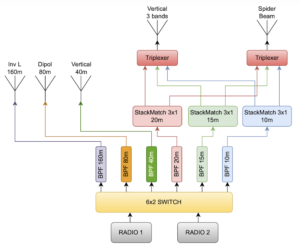
A triplexer-based system is easily scalable. To have three antennas in three different directions (a total of nine virtual monoband antennas), simply install three tribanders pointing in different directions (e.g., Europe, USA, Asia). We connect a dedicated triplexer to each, and combine outputs from the same bands using StackMatchy. This allows each operator to access all three directions on their band simultaneously. What’s more, you don’t have to buy three sets of filters. Simply install one filter per band, and you still have full station flexibility.
In summary, the triplexer is a revolution that allows you to build a station with professional capabilities at a lower cost and using less space.
If you have more questions about triplexers or configuring your station, write to us at: info@so9i.com
